


“A penny saved is a penny earned.”
-Benjamin Franklin
Here’s what you need to know this week:
· Is Social Security really running out of money?
Social Security’s Security
You may have seen talk on the news lately about the future of Social Security: discussions of the solvency of the fund, potential cuts to benefits, discussions of tax rate hikes and the like. Today we’re going to cut through the noise and give you a better understanding of where we are and what options are available to lawmakers as we approach insolvency.
First, let’s look at the fund itself. The Old-Age and Survivors Insurance (OASI) trust fund is what funds Social Security and Medicare payments. At our current spending rate, the fund is on pace to be depleted by 2032:
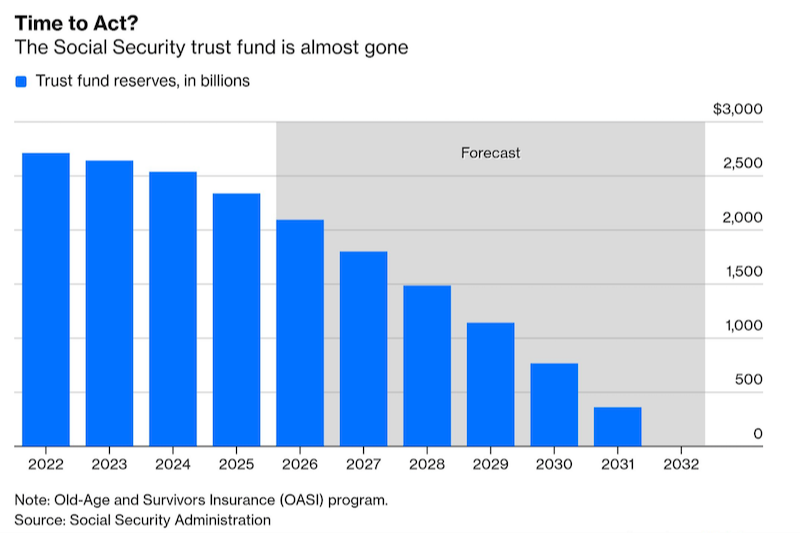
This trust is funded by a payroll tax of 12.4% on salaries up to $184,500. One possible solution is raising or eliminating the cap at $184,500 and taxing all income with the 12.4% payroll tax. This idea has already found bipartisan support in Congress: Republican Senator Bernie Moreno and Democratic Senator Elizabeth Warren have drafted a joint proposal to address this funding gap and explore raising or eliminating the cap[1]. However, this strategy is not without detractors, and opponents say that raising this cap would effectively be a wealth transfer from young families to the elderly, a wealthier cohort by all metrics.
You may be wondering why the fund is depleting so fast. Didn’t the architects of Social Security plan ahead? They did, but a few factors have played out differently than assumed. The US fertility rate has steadily fallen since 1971, meaning there are fewer workers in the workforce paying taxes. Second is tax rates: income tax rates have fallen dramatically since 1985, further reducing federal coffers and leading lawmakers to tap the OASI trust for other expenses. Third is declining immigration, which also means fewer tax-paying workers. Fourth is increased life expectancy, meaning people are living longer and drawing benefits for much longer than the creators of Social Security anticipated.
If no changes are made then the first move will be a reduction in benefits. The Committee for a Responsible Federal Budget projects that all Social Security benefits will be slashed by 22% in 2032 if no new funding is found[1]. While this is better than *no* benefits, it is still a noticeable reduction. One potential funding option would be combining the OASI trust with the federal Disability Insurance (DI) trust which would fund both programs through 2034 and then see a cut of 17% if no revisions are made[2].
From here, Social Security benefits would be entirely dependent on payroll taxes. This would be enough money to keep the program going indefinitely although it would put cost-of-living adjustments in jeopardy. There are only four potential options for keeping the program funded:
1) Raise taxes
2) Cut benefits
3) Raise the retirement age
4) Borrow/print more money
All four of these have political drawbacks. Like I said above, raising taxes will be unpopular with active workers. Cutting benefits will obviously be unpopular with active benefit recipients. Raising the retirement age will also be unpopular with younger people for obvious reasons. Borrowing or printing more money to fund the program sounds nice in theory, but as we saw during COVID, pumping trillions of excess dollars into the economy drives inflation higher and would defeat the point of paying out more benefits.
Unfortunately, there is no satisfying single answer here, and the most likely outcome is a mix of the options listed above. A funding bill in Congress may look something like raising the payroll tax cap to ~$300,000 salary, placing a cap on the amount of monthly benefits wealthy retirees receive, and slowly increasing the full retirement age (FRA) to 68-70. Regardless of what they decide, Congress can kick the can down the road no longer. Senators have six-year terms, which means Senators that win their elections this November will be in office in 2032. Regardless of outcome, Social Security funding will likely be one of, if not THE, biggest political story over the coming decade.
What’s Happening Downtown
This weekend is Military Appreciation Weekend at the OKC Museum of Art. This event features free entry to the museum for all active military service members, veterans, and their families. Click below to read a full list of times and activities:
· OKC Museum of Art Military Appreciation Weekend
To read more from our blog, click here
Written by: Kane Ogle, CFP®
Steve Beck, Kane Ogle, CFP®, Amber Eduvigen, CFP®, Cale Olbert, CFP®, Brett Valentine, CFP®, Brandon Ingerson, Bill Daniel, Sam Postich, Jenni Hess, Hannah Hartman